
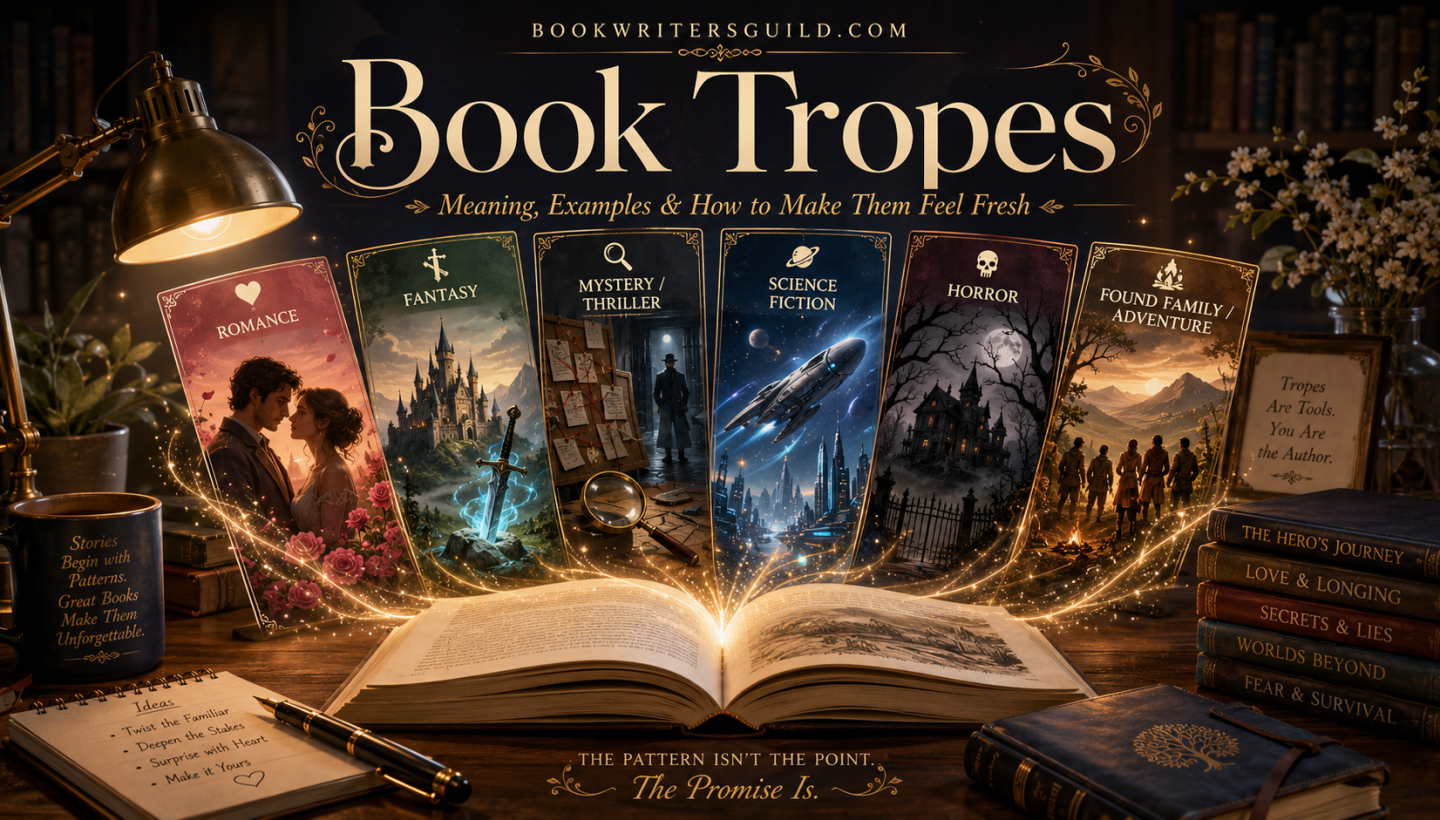
80+ Book Tropes by Genre: Meaning, Examples and How to Make Them Feel Fresh
A young woman inherits a crumbling seaside inn and discovers the only person who can help restore it is the rival she has disliked since childhood.
A quiet student learns they are the missing heir to a kingdom, but the magic that could save it is forbidden.
A group of wedding guests is trapped on an island after the host is found dead, and everyone had a reason to want him gone.
You probably recognise the shape of these stories already.
That does not make them bad. It makes them book tropes.
A trope is a familiar story pattern readers recognise and often actively enjoy: enemies to lovers, the chosen one, the amateur sleuth, the haunted house, the ticking clock or the return to the hometown.
The question is not whether your story uses tropes. Almost every story does.
The question is whether you use them to deliver an emotional promise readers love, while still giving them characters, stakes and surprises they have not experienced in exactly the same way before.
What Is a Trope in Books?
A trope in books is a recognizable pattern in a story’s characters, relationships, conflict, setting or plot.
Examples include:
- Two rivals gradually falling in love.
- An ordinary person discovering hidden power.
- A detective gathering suspects in one isolated location.
- A character returning home and confronting the past.
- A family hiding a secret that changes everything.
Tropes help readers quickly understand what kind of experience a story may offer.
| Trope | Reader Expectation |
| Enemies to lovers | Conflict, banter and emotional tension becoming romance |
| Found family | Lonely characters building belonging together |
| Closed-circle mystery | A limited suspect pool and carefully planted clues |
| Magical school | Discovery, training, rivalry and hidden rules |
| Return to hometown | Memory, unfinished relationships and personal change |
A trope is not automatically predictable. It is a starting promise. Your characters, complications and consequences determine whether it feels powerful or tired.
Trope vs Cliché: What Is the Difference?
A trope is familiar. A cliché feels familiar without adding anything meaningful.
| Trope | Cliché Version | Fresher Version |
| Chosen one | The hero is important simply because prophecy says so. | The prophecy is real, but accepting it costs the hero the life they wanted. |
| Fake dating | Two people pretend to date and obviously fall in love. | One needs the lie to protect a family business; the other risks losing the trust of someone they care about. |
| Haunted house | A creepy house contains a ghost. | The house reveals memories differently to each family member, exposing why they refuse to leave. |
| Return to hometown | A character goes home and reunites with an old love. | The town celebrates a history the protagonist knows was built on a lie. |
The best storytelling tropes create expectation, then deepen or complicate that expectation through character.
Book Tropes List by Genre
Romance Book Tropes
Romance tropes tell readers what kind of emotional tension and payoff to expect.
| Trope | Reader Promise | How to Make It Fresh |
| Enemies to lovers | Conflict transforms into attraction. | Make the disagreement meaningful, not just sarcastic banter. |
| Friends to lovers | Familiar affection becomes romantic risk. | Show why changing the friendship feels dangerous. |
| Fake relationship | Pretended intimacy becomes real. | Give each character a different reason to need the lie. |
| Forced proximity | Characters cannot avoid one another. | Use closeness to expose vulnerability or a secret. |
| Second chance romance | Former lovers confront what separated them. | Make forgiveness require genuine change. |
| Marriage of convenience | A practical arrangement becomes emotional. | Make the arrangement solve one problem while creating another. |
| Forbidden love | Desire conflicts with duty, safety or belonging. | Ensure the barrier has real consequences. |
| Love triangle | The protagonist must choose between two futures. | Make each relationship represent a different identity or life. |
| Fated mates | Love feels inevitable or supernatural. | Preserve choice: destiny should not replace consent or character agency. |
| Grumpy/sunshine | Opposing personalities create warmth and friction. | Give both characters depth beyond cheerfulness or coldness. |
Original Romance Trope Example
A burnt-out wedding photographer agrees to fake-date the cheerful owner of a struggling flower farm to win a destination wedding contract. She needs the money; he needs the publicity. Their public chemistry works perfectly, but privately she believes love always becomes another obligation.
Tropes used: fake relationship, grumpy/sunshine, forced proximity.
Fantasy Bookish Tropes
Fantasy tropes give readers familiar ways into unfamiliar worlds.
| Trope | Reader Promise | How to Make It Fresh |
| The chosen one | One person may decide the fate of the world. | Ask what destiny takes away from them. |
| The reluctant hero | An ordinary person resists a dangerous calling. | Give them a convincing reason to refuse. |
| The quest | Characters journey toward an essential goal. | Make every stage alter the characters or stakes. |
| The mentor | A guide prepares the hero for danger. | Give the mentor limits, motives or serious mistakes. |
| Magical school | Readers learn the rules of power alongside the character. | Let the institution protect harmful traditions. |
| Forbidden magic | Power comes with danger or social cost. | Make its consequences more complex than punishment. |
| The lost heir | A hidden identity changes the political order. | Show why the character may not want the inheritance. |
| Ancient artifact | An object carries great power or danger. | Make using it reveal character rather than solve everything. |
| Found family | Unrelated characters become emotionally loyal. | Let trust develop through difficult choices. |
| Good versus evil | Characters confront a clear threat. | Give the conflict moral pressure, temptation or divided loyalty. |
Original Fantasy Trope Example
A palace archivist discovers that her ability to read memories from burned books marks her as the missing royal heir. The only people willing to protect her are three smugglers transporting forbidden magical relics across the kingdom.
Tropes used: lost heir, forbidden magic, found family, quest.
Mystery Tropes
Mystery readers want a puzzle they can attempt to solve before the reveal.
| Trope | Reader Promise | How to Make It Fresh |
| The amateur sleuth | An ordinary person uncovers extraordinary wrongdoing. | Tie the investigation personally to their life. |
| The grizzled detective | An experienced investigator faces another difficult case. | Give their past a direct effect on the investigation. |
| The red herring | Readers are led toward the wrong answer. | Make the misleading clue truthful but misinterpreted. |
| The unlikable victim | Many suspects have believable motives. | Reveal unexpected tenderness as well as cruelty. |
| The closed circle | The culprit must be among a limited group. | Choose a setting that increases pressure. |
| The secret from the past | Old actions explain present danger. | Make the present conflict equally compelling. |
| The dramatic reveal | Clues finally assemble into the truth. | Surprise readers without hiding essential evidence unfairly. |
Original Mystery Trope Example
During a storm, six former classmates are stranded overnight in the museum where they once volunteered. When their retired history teacher is found dead beside a stolen exhibit, every suspect remembers a different version of the school scandal he buried thirty years earlier.
Tropes used: closed circle, unlikable victim, secret from the past, dramatic reveal.
Thriller and Suspense Tropes
Thriller tropes promise pressure, danger and escalation.
| Trope | Reader Promise | How to Make It Fresh |
| The ticking clock | Disaster must be prevented before time runs out. | Make the deadline force painful decisions. |
| The framed protagonist | An innocent character must prove the truth while being hunted. | Take away the systems they once trusted. |
| The unreliable narrator | The truth is distorted by the storyteller. | Plant fair signals that something is wrong. |
| The conspiracy | Hidden powers control more than expected. | Anchor the large threat in a personal loss. |
| The stalker | Ordinary life becomes unsafe. | Focus on invasion of routines, privacy and trust. |
| The twist ending | A revelation changes the story’s meaning. | Make the ending surprising in the moment, logical afterward. |
Science Fiction Tropes
The strongest science fiction tropes use speculative ideas to create human consequences.
| Trope | Reader Promise | How to Make It Fresh |
| Artificial intelligence | Machines challenge ideas of control and consciousness. | Explore who benefits from calling intelligence “artificial.” |
| Dystopian society | A future system turns familiar problems into oppression. | Build the world around a believable trade-off. |
| Time travel | Characters can alter or become trapped by time. | Make every correction create an emotional cost. |
| First contact | Humanity meets life beyond itself. | Focus on communication, fear or misunderstanding. |
| Space travel | Distance creates danger, wonder and isolation. | Give the journey consequences beyond broken machinery. |
| Clones or engineered humans | Identity and personhood become contested. | Let engineered people define themselves. |
| Post-apocalyptic survival | Characters rebuild after collapse. | Focus on the society they choose to create next. |
Original Science Fiction Trope Example
A linguist aboard a failing research vessel receives a message from an unknown intelligence that uses recordings of her dead mother’s voice. The crew believes it is a manipulation. She believes it may be the first attempt at genuine contact.
Tropes used: first contact, space travel, artificial intelligence, isolated setting.
Horror Tropes
Horror tropes transform safety, memory and trust into sources of dread.
| Trope | Reader Promise | How to Make It Fresh |
| The haunted house | Home becomes dangerous. | Connect the haunting to what the residents refuse to admit. |
| The cursed object | Possession brings consequences. | Make keeping the item emotionally tempting. |
| The monster | Something terrifying hunts or changes people. | Let the monster embody a deeper fear. |
| The isolated setting | Characters cannot easily escape or find help. | Make isolation partly chosen. |
| The traumatic past | Buried history returns. | Reveal why silence once felt safer than truth. |
| The final survivor | One character reaches the end. | Make survival demand sacrifice or moral compromise. |
| The evil next door | Horror hides behind familiarity. | Make trust, not violence, the first danger. |
Action and Adventure Tropes
Action and adventure depend on forward momentum, escalating obstacles and high-stakes choices.
| Trope | Reader Promise | How to Make It Fresh |
| The treasure hunt | A dangerous search leads toward discovery. | Make the treasure challenge the hero’s motives. |
| The MacGuffin | Everyone competes for one crucial object. | Make characters disagree about what it should be used for. |
| The ticking clock | The mission has an urgent deadline. | Let speed create mistakes and consequences. |
| The double-cross | An ally becomes a threat. | Establish real trust before breaking it. |
| The impossible escape | Skill and nerve overcome a deadly trap. | Base the escape on earlier preparation. |
| The larger-than-life threat | Many people are at risk. | Tie public stakes to one personal relationship. |
Young Adult Tropes
Young adult stories can belong to many genres, but they often centre identity, independence and belonging.
| Trope | Reader Promise | How to Make It Fresh |
| The outsider | A young person searches for belonging. | Let difference become a strength and a complication. |
| First love | New emotion arrives with intensity and uncertainty. | Make romance part of growth, not the entire identity arc. |
| Found family | Friends become safety and home. | Show support being earned through action. |
| Absent or unreliable adults | Young people must take responsibility. | Make adults human rather than conveniently useless. |
| Secret powers or hidden identity | Self-discovery becomes external conflict. | Connect the revelation to a difficult choice. |
| The rebellion | A young person challenges injustice. | Show what change costs, not only what it achieves. |
Children’s Book Tropes
In children’s stories, familiar patterns help younger readers follow emotional journeys clearly.
| Trope | Reader Promise | How to Make It Fresh |
| Talking animals | Big feelings become accessible and playful. | Give the animal a child-sized problem with real emotion. |
| Learning to share | Fairness and generosity create conflict. | Avoid preaching; let the character discover the benefit. |
| The power of friendship | Cooperation helps solve a problem. | Give each friend a meaningful contribution. |
| Facing a fear | Courage grows through manageable steps. | Let bravery mean acting while still nervous. |
| Trying three times | Repetition builds anticipation and payoff. | Make each attempt smarter than the last. |
| The big imagination | Ordinary life becomes extraordinary. | Let fantasy reveal something emotionally true. |
Historical Fiction Tropes
In historical fiction, tropes should grow naturally from the pressures of time, place and society.
| Trope | Reader Promise | How to Make It Fresh |
| Real events, fictional characters | Readers experience history personally. | Give the character goals beyond witnessing events. |
| Historical figures as characters | Famous lives intersect with fiction. | Use them only where they affect the story meaningfully. |
| Dual timeline | Past and present reveal one another. | Make both timelines emotionally necessary. |
| War and survival | Private lives collide with public crisis. | Centre intimate choices rather than spectacle alone. |
| Social constraints | Era-specific rules limit freedom. | Make the historical setting create the central conflict. |
Contemporary Fiction Tropes
Contemporary fiction turns recognisable life experiences into emotional pressure.
| Trope | Reader Promise | How to Make It Fresh |
| Family drama | Old relationships create present conflict. | Give each family member a defensible version of events. |
| Coming of age | A character becomes someone new. | Remember that adults can come of age too. |
| Return to hometown | A place forces confrontation with the past. | Change the town as well as the returning character. |
| A death in the family | Loss rearranges relationships. | Focus on what grief reveals rather than using death as decoration. |
| Reinvention | A character attempts a new life. | Let the old self resist disappearing. |
Literary Tropes
Literary tropes often appear through voice, memory, family and interior change rather than high-concept plotting.
| Trope | Reader Promise | How to Make It Fresh |
| The dysfunctional family | History and silence shape relationships. | Let love exist alongside harm and resentment. |
| The small town | Community, reputation and secrets create pressure. | Give the setting its own contradictions. |
| The unresolved ending | Meaning remains open rather than neatly solved. | Resolve the emotional question even if plot remains ambiguous. |
| Childhood memories | The past reshapes the present. | Show memory as selective or unreliable. |
| The interior journey | The deepest transformation occurs within. | Use external pressure to make inner change visible. |
How to Choose the Right Book Tropes for Your Story
The best trope is not simply the most popular one. It is the one that strengthens the emotional experience your book promises.
Start With the Reader Feeling
| You Want Readers To Feel… | Consider Tropes Such As… |
| Romantic tension | Enemies to lovers, fake relationship, forced proximity |
| Belonging and warmth | Found family, return to hometown, power of friendship |
| Suspicion and puzzle-solving | Closed circle, red herring, secret from the past |
| Urgency and danger | Ticking clock, framed protagonist, impossible escape |
| Wonder and discovery | Magical school, first contact, ancient artifact |
| Dread and uncertainty | Haunted house, unreliable narrator, evil next door |
| Emotional reflection | Childhood memories, family drama, interior journey |
Use a Trope Stack
A single trope gives readers a signal. Two or three compatible tropes can give your book a distinctive hook.
| Genre | Trope Stack | Story Hook |
| Romance | Second chance + forced proximity | Former fiancés must jointly restore the restaurant they once planned to open together. |
| Fantasy | Forbidden magic + found family + quest | Exiled healers transport a dangerous child across a kingdom that fears her gift. |
| Mystery | Closed circle + secret from the past | Guests at a memorial retreat discover the person they came to honour may have ruined all their lives. |
| Historical Fiction | Dual timeline + social constraints | A modern archivist discovers letters revealing why her great-grandmother vanished from public record. |
| Thriller | Framed protagonist + ticking clock | A security analyst has one night to stop an attack planned using her stolen identity. |

|
Got the Trope Down? Now Write the Book. Levon is an all-in-one author workspace to draft chapters, shape your book’s structure, apply professional typography, and export a publishing-ready file — so your fresh take on a familiar trope actually gets finished. Join the Levon Waitlist → |
How to Make Common Tropes Feel Original
1. Change the Cost
A trope feels fresh when winning comes with an unexpected price.
A lost heir does not simply gain a throne; they lose anonymity, safety or the family who raised them.
2. Give Characters Conflicting Reasons to Want the Same Thing
In a marriage of convenience, one person may need social protection while the other needs access to an inheritance. Their agreement works until their private goals clash.
3. Change Who Has the Power
In a mentor story, the student may discover that the mentor needs saving from the institution they built.
4. Let the Trope Affect More Than Plot
A return to hometown story becomes stronger when the setting changes the character’s language, behaviour and sense of self, not merely their romantic opportunities.
5. Deliver the Promise Before You Subvert It
Readers who choose enemies to lovers want tension. Readers who choose a closed-circle mystery want suspects and clues. Readers who choose found family want emotional belonging.
Surprise works best after the story fulfils the core pleasure readers came for.
How Tropes Help Readers Find Books
Bookish tropes are useful beyond drafting because they describe reading experiences clearly.
A reader may not search for “a 95,000-word romantic fantasy with dual narration,” but they may immediately recognise:
- Enemies to lovers romantasy
- Found family fantasy adventure
- Closed-circle murder mystery
- Second chance small-town romance
- Haunted house gothic horror
Use accurate trope language in:
- Your book description
- Website copy
- Reader-facing graphics
- Social media posts
- Advance-reader messaging
- Series pages
- Advertising concepts
- Metadata and keywords where appropriate
Do not force popular tropes into a book that does not actually deliver them. Attracting the wrong reader may win a click, but it risks disappointment and poor reviews.
Frequently Asked Questions About Book Tropes
What is a trope in books?
A trope is a recognisable pattern in a book’s character relationships, plot, setting or conflict. Examples include enemies to lovers, the chosen one, found family and the unreliable narrator.
Are book tropes bad?
No. Book tropes are storytelling patterns readers often enjoy. They become disappointing only when they are poorly developed, misleadingly marketed or repeated without distinctive characters and consequences.
What are some common book tropes?
Popular common book tropes include enemies to lovers, fake dating, forced proximity, the chosen one, magical school, found family, the amateur sleuth, the ticking clock, the haunted house and return to hometown.
What is the difference between a trope and a cliché?
A trope is familiar but can still be written creatively. A cliché is a familiar idea handled without fresh character depth, meaningful conflict or surprise.
Why do readers like tropes?
Tropes help readers find the emotional experience they are in the mood for, whether that is romance, comfort, suspense, danger, discovery or fear.
Can a book use more than one trope?
Yes. Most books use several tropes. Combining compatible tropes can make the premise clearer and more appealing, provided the story fulfils the promises those tropes create.
Final Thoughts on Tropes in Books
Readers do not avoid familiar story patterns simply because they recognise them.
They return to book tropes because they love particular feelings: the tension before rivals fall in love, the relief of lonely people becoming family, the pleasure of solving a mystery, the wonder of discovering a magical world or the ache of returning to a place that still remembers who you used to be.
Use tropes deliberately.
Know what they promise.
Build characters whose choices make the pattern feel personal.
Complicate the familiar rather than rejecting it.
Then describe the book honestly so the readers who want that experience can find it.
A familiar doorway can still lead somewhere unforgettable.
Free Resource for Writers
Turn Familiar Ideas Into Stories Readers Remember
Download The Imagination Manifesto free and discover practical inspiration for finding stronger story ideas, developing memorable characters and moving your next book forward.
Everyone Has An Imagination: An Inspiration and Guide to Start Writing
Get this for FREE! (sold for $4.99)
We respect your privacy.