Parts of a book: what are the parts of a book in order? Complete guide to front matter, back matter and sections of a book (2026)
If you want your book to feel professional, complete, and credible, you need more than good writing. You need structure.
That is where most authors get stuck. They have the idea. They have the chapters. They may even have a finished manuscript. But they are still unsure how the whole thing should be assembled. What comes first? What is optional? What belongs before chapter one? What belongs after the last page?
That is exactly why understanding the parts of a book matters.
A strong book is not just written. It is built. Every section has a job. Every page has a place. And when the structure is right, the reader feels it immediately.
What are the parts of a book
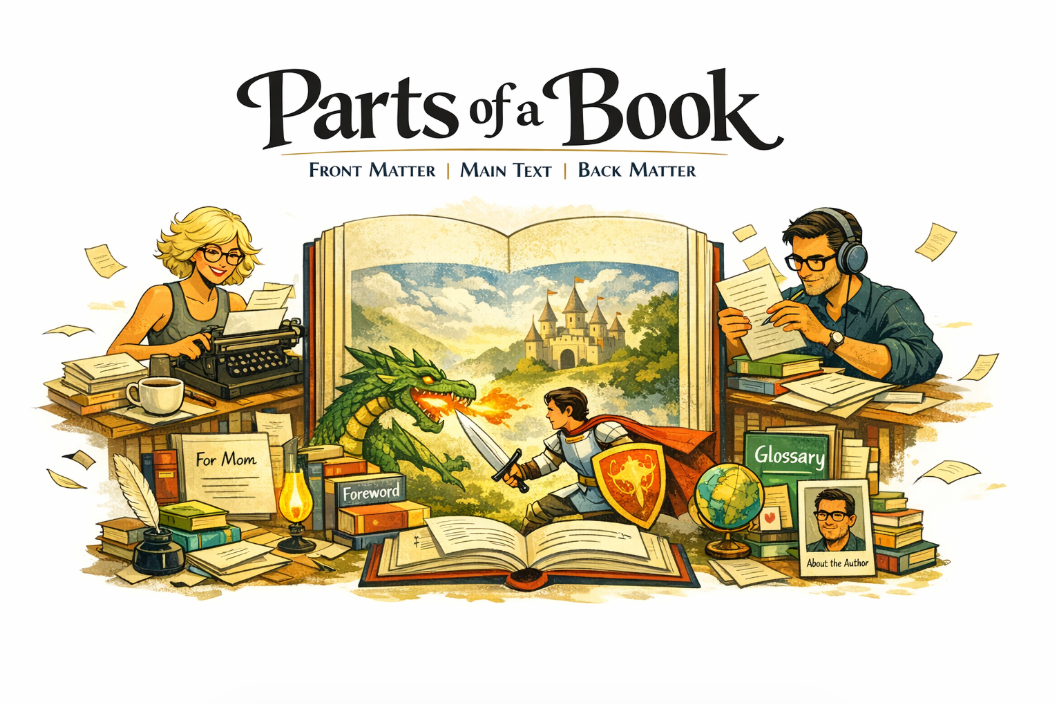
The clearest answer is this: the parts of a book usually fall into three main divisions:
- front matter of a book
- the main text
- back matter of a book
That framework is standard across publishing guidance. Front matter covers the opening pages before the main text, the body contains the core material, and back matter includes the supporting material that comes after the main content ends.
That simple three-part model is the easiest way to understand book structure. Once you grasp it, everything else starts to make sense.
Parts of a book (in order)
For most books, the practical parts of a book in order look like this:
- Half title or title page
- Copyright page
- Dedication, praise, or acknowledgments if needed
- contents of a book / book contents
- Foreword, preface, prologue, or introduction if needed
- Main chapters or body text
- Conclusion, epilogue, or final chapter if needed
- Appendix, glossary, bibliography, index, author bio, or reader CTA
That order can vary by genre and format, but it closely matches standard publishing workflows, including Amazon KDP’s guidance for front matter order and Pressbooks’ broader book-structure model.
The key point is not that every book must include every item. It is that a professional book follows a logical reading sequence. The beginning prepares the reader, the middle delivers the value, and the ending extends or supports the experience.
Front matter of a book
The front matter of a book is everything that appears before the main text starts. Its purpose is simple: it prepares the reader, identifies the book, handles legal and publishing details, and creates a clean entry into the main content. Common front matter includes the title page, copyright notice, dedication, acknowledgments, preface, introduction, and more.
This section matters more than many writers realize. Weak front matter makes a book feel sloppy before the reader even reaches chapter one. Strong front matter makes the book feel intentional from the first page of a book.
Title page
The title page is the formal opening of the book. It usually includes the title, subtitle if there is one, and the author name. It sounds simple, but it does an important job: it tells the reader exactly what work they are entering.
A title page should feel clean, not cluttered. Its power comes from clarity.
Example:
A nonfiction book might open with:
The Psychology of Focus
How to Build Deep Work Habits in a Distracted World
by Jane Smith
That is simple, direct, and professional. The title page does not need to do more than identify the work clearly.
Copyright page
This is a standard part of the book and one of the most important professional pages. It usually includes copyright information, edition details, legal notices, and ISBN data where relevant. Publishing guidance consistently treats the copyright page as a core front-matter element, especially for print and ebook distribution.
Example:
A copyright page may include:
- Copyright © 2026 Jane Smith
- All rights reserved
- ISBN
- Publisher name
- disclaimer language if needed
If the title page introduces the work, the copyright page legitimizes it.
Contents of a book and book contents
The table of contents is one of the most useful sections of a book, especially in nonfiction. It shows readers how the book is organized and helps them navigate the pages in a book quickly. Standard publishing guidance treats a table of contents as essential for most nonfiction and often optional for many fiction books.
This is where many authors make a smart decision or a poor one. In nonfiction, a clear contents page increases usability. In fast-moving fiction, it can be optional because the reading experience depends less on navigation and more on momentum.
Example:
A business book might list:
- Chapter 1: Why Strategy Fails
- Chapter 2: The Real Cost of Confusion
- Chapter 3: How to Build a Repeatable System
That instantly tells the reader what is coming and builds confidence.
In nonfiction, this is often essential. In fiction, it may be optional.
Dedication and acknowledgments
These sections are optional, but they can add warmth and credibility when used well. A dedication is brief and personal. Acknowledgments recognize the people who contributed to the project.
The rule here is simple: include them if they add value, not because you feel obligated.
Example dedication:
For my mother, who taught me to finish what I start.
Example acknowledgment:
Special thanks to the early readers, editors, and researchers who helped shape this manuscript.
These sections work best when they are brief and sincere.
Foreword, preface, and introduction
These three are often confused, but they do different jobs. A foreword is written by someone other than the author and adds credibility or outside perspective. A preface is written by the author and explains how or why the book came to exist. An introduction prepares the reader for what the book will actually cover.
Example:
- Foreword: written by a respected expert endorsing the book
- Preface: the author explains the story behind writing it
- Introduction: the author shows the reader what they will learn and why it matters
That distinction matters. A lot of books become bloated at the beginning because authors stack these sections without a real reason. Most books do not need all three. The strongest choice is usually the one that gets the reader into the core experience fastest.
Epigraph and prologue
An epigraph is a short quotation or excerpt placed at the beginning of a book or section to suggest mood, theme, or direction. A prologue is different: it is part of the narrative experience, most often used in fiction to establish context before the main story begins.
Example epigraph:
“We are what we repeatedly do.”
Example prologue:
A thriller might open with a crime scene that takes place ten years before chapter one.
Used well, both can be powerful. Used carelessly, both can feel like delay.

|
Know the Structure. Now Build the Book. Levon is an all-in-one author workspace that already knows where front matter, chapters and back matter belong — so you can write and organize your manuscript without piecing the structure together yourself. Get Early Access to Levon → |
The main text: what happens inside a book
Everything inside a book has one responsibility: deliver the promise of the book.
This is the main body, the core content of a book, and the reason the reader bought it in the first place. Once the opening pages are over, the structure should become almost invisible. The reader should feel guided, not managed.
Chapters and internal sections of a book
Chapters are the backbone of the main text. They divide the material into clear, readable units. Within those chapters, smaller sections of a book improve pacing, clarity, and flow.
Example:
A self-help book chapter might be organized like this:
- Chapter 4: Build Better Habits
- Why habits fail
- The two-minute starting rule
- How to create habit triggers
- Weekly review checklist
That structure helps the reader absorb the material without getting lost.
Parts, sections, and pacing
Some books use chapters only. Others divide the book into larger parts and then chapters within those parts. This is especially useful in longer nonfiction and narrative nonfiction.
Example:
- Part I: The Problem
- Part II: The Shift
- Part III: The System
That kind of structure helps the reader feel progress across the full book, not just within individual chapters.
Fiction and nonfiction use structure differently
The parts of a novel are often leaner than the structure of a nonfiction guide. Fiction usually prioritizes immersion, pacing, and chapter rhythm. Nonfiction usually benefits more from navigational elements, explanatory openings, appendices, glossaries, and references.
The parts of a booklet are usually simpler still. A booklet often needs only the essentials: title, brief opening, core material, and a clean ending.
That is why authors should stop asking for one universal formula and start asking what structure best serves the reading experience.
Back matter of a book
The back matter of a book includes everything that appears after the main text ends. This material is not filler. It is where a book can deepen trust, extend usefulness, and create the reader’s next step. Standard publishing guidance places items such as appendices, bibliographies, glossaries, epilogues, afterwords, and source material in back matter.
This is one of the biggest missed opportunities in self-publishing. Too many books stop instead of finishing strong.
Appendix, glossary, bibliography, and index
These sections are especially valuable in nonfiction. They help you add supporting material without interrupting the main reading experience. A glossary clarifies terms. A bibliography or references section strengthens authority. An appendix gives extra material a proper home. An index can make a book far more useful in print.
Example appendix:
A productivity book may include a printable weekly planning template.
Example glossary:
A finance book may define terms like “liquidity,” “yield,” and “market cap.”
Example bibliography:
A history book may list all key sources used in the research.
Example index:
A print reference book may include page-based entries for quick lookup.
These are not decorative. They are functional.
Afterword, epilogue, and author’s note
These sections work best when they add something the main text should not carry. An epilogue extends a story. An afterword reflects on the work after the main content has landed. An author’s note can add context, research insight, or closing reflection.
Example epilogue:
A novel may show what happened to the characters six months later.
Example afterword:
A nonfiction author may reflect on how the ideas have evolved since the first edition.
Example author’s note:
A historical writer may explain what was researched, what was fictionalized, and why.
The key is restraint. A closing section should enrich the book, not dilute the ending.
Author bio and reader call to action
An author bio is one of the smartest book parts you can include. It tells readers who you are and why they should care about your work.
A reader call to action is just as powerful. If someone has reached the back of a book, they are engaged. That is the ideal moment to invite them to join your list, visit your site, read another title, or stay connected.
Example bio:
Jane Smith is a productivity coach who has trained founders, writers, and remote teams in over 20 countries.
A reader call to action matters just as much.
Example CTA:
Enjoyed this book? Join my newsletter for bonus chapters, tools, and future releases.
If someone has reached the back of a book, they are engaged. That is the perfect moment to guide them toward the next step.
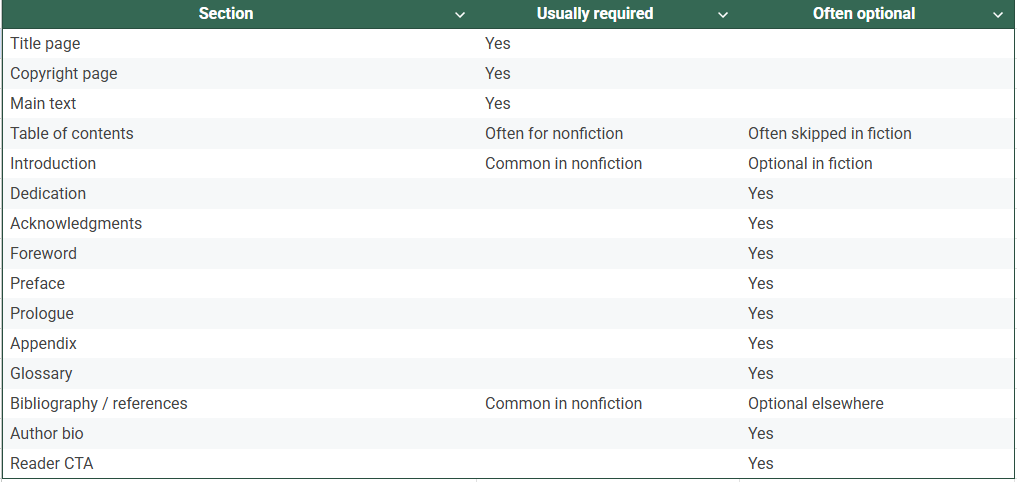
Which sections of a book are essential?
Not every book needs every section. That is what confuses so many writers.
The essentials for most books are:
- title page
- copyright page
- main text
Commonly important for nonfiction:
- contents of a book
- introduction
- appendix or references
Often optional:
- dedication
- acknowledgments
- foreword
- preface
- epigraph
- prologue
- glossary
- bibliography
- author bio
- CTA
The standard guidance from publishing platforms and book-production tools is consistent on this point: some elements are foundational, while many others are optional and should be chosen based on the type of book and the needs of the reader.
That is the real principle. Do not include a section because other books have it. Include it because your book needs it.
Common mistakes authors make with the parts of a book
Most weak books are not ruined by bad ideas. They are weakened by bad structure.
The most common mistakes are:
- too much opening material before the reader reaches the real content
- using a preface, foreword, and introduction when one would do
- weak chapter organization
- no clear book contents for a nonfiction title
- no useful ending material
- no next step for the reader after the final page
These mistakes create friction. They make a book feel slower, less confident, and less finished than it should.
How the components of a book work together
The strongest books treat structure like architecture.
The opening pages establish identity and trust.
The middle delivers the real experience.
The ending deepens value and extends the relationship.
That is how the components of a book should work: not as random pieces, but as connected systems. When the sequence is right, the book feels inevitable. When it is wrong, even good writing feels scattered.
FAQ
what are the parts of a book called?
The main parts of a book are usually called the front matter, the main text, and the back matter. Inside those larger divisions, you will find sections such as the title page, copyright page, table of contents, chapters, appendix, glossary, and author bio.
what are the parts of a book?
The simplest answer is: opening pages, main content, and closing pages. In publishing terms, that usually means front matter of a book, body text, and back matter of a book.
what are parts of a book?
What are parts of a book is simply another way of asking how a book is structured. The answer depends on the type of book, but most include a title page, copyright page, main text, and sometimes extra sections like introductions, appendices, or glossaries.
What is the end of a book called?
The end of a book is usually referred to as the closing section or, more specifically, the back matter of a book. That can include an epilogue, afterword, appendix, glossary, bibliography, author bio, or a call to action.
What is included in front matter of a book?
The front matter of a book often includes the title page, copyright page, dedication, acknowledgments, table of contents, foreword, preface, and introduction. Not every book needs all of them.
What is included in back matter of a book?
The back matter of a book may include an appendix, glossary, bibliography, index, afterword, author bio, and reader CTA. These sections are especially valuable in nonfiction and professional publishing.
Final thoughts on the parts of a book
If you want the clearest possible answer, here it is:
A book is built in three layers: front matter of a book, the main text, and back matter of a book. Within those layers, the most important sections of a book are the ones that identify the work, guide the reader, deliver the real value, and complete the experience with purpose.
That is the version worth publishing.