
Point of View vs Perspective: The Difference, Meaning and Examples for Writers
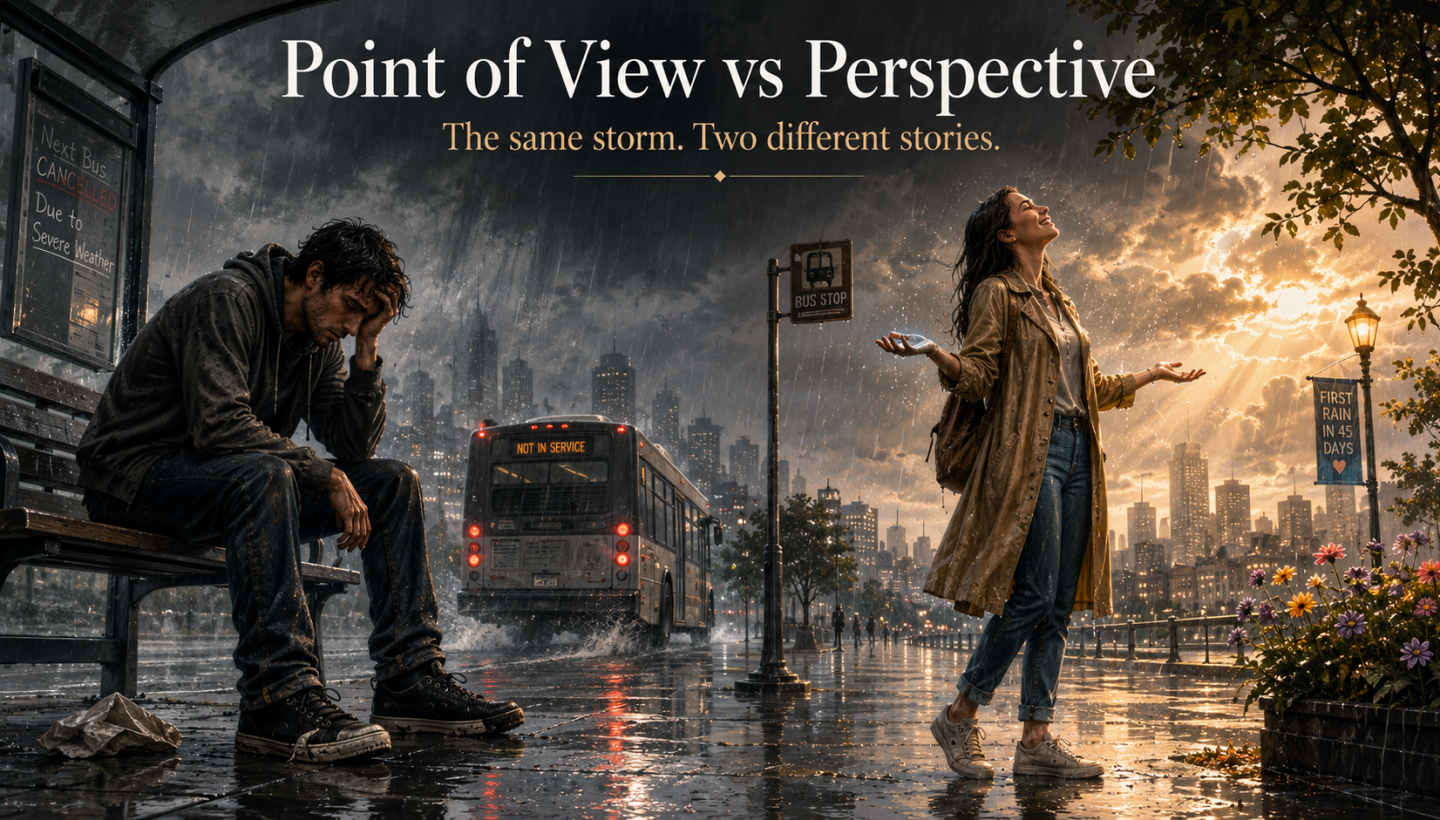
Two characters can stand in the same rainstorm and experience completely different stories.
One sees ruined shoes, a missed bus and another miserable day. The other sees the first rain after a drought and stops to smile.
The scene has not changed. The lens has.
That distinction sits at the heart of point of view vs perspective, two writing concepts that are closely related but not interchangeable.
In simple terms:
- Point of view determines the narrative position: who tells the story, which pronouns are used and whose thoughts the reader can access.
- Perspective determines the interpretation: how a narrator or character understands what happens because of their history, desires, fears, beliefs, and blind spots.
A writer who understands both can do far more than choose between “I” and “she.” You can control intimacy, suspense, bias, emotional impact and the meaning readers take from a scene.
This guide explains what a ” point of view ” is, what perspective is, the difference between them, the main POV types, strong literary and original perspective examples, and practical ways to make every character sound as though they have truly lived a different life.
Point of View vs Perspective: The Quick Difference
| Element | Point of View | Perspective |
| Core question | Who tells or experiences the story? | How does that person interpret the story? |
| Technical focus | Pronouns, narrator position and access to thoughts | Values, emotions, assumptions, memories and biases |
| Simple example | “I walked into the courtroom.” | “The courtroom smelled like judgment before anyone spoke.” |
| Writer controls it through | First person, second person, third person limited, omniscient or objective narration | Character history, motivation, culture, relationships, fears and desires |
| Can it change? | Yes, but changes must be deliberate and controlled | Yes; perspective can develop as a character learns or changes |
| Why it matters | Controls reader distance and information | Controls meaning and emotional truth |
The clearest way to remember it
Point of view is the camera position. Perspective is the lens through which the camera sees.
Two stories can use the same point of view and still feel entirely different because their narrators carry different perspectives.
What Is Point of View in a Story?
Point of view is the narrative position from which a story is told. It determines who is speaking, how close readers are allowed to get and what information is available to them.
Many explanations reduce POV to pronouns:
- “I” means first person.
- “You” means second person.
- “He,” “she” or “they” means third person.
That is useful, but incomplete.
Pronouns help identify a narrative form, yet they do not fully explain how a story works. Both third-person limited and third-person omniscient use “he,” “she” or “they,” but they create very different reading experiences because they control access to knowledge differently.
A more useful point of view meaning in literature is:
Point of view is the narrative relationship between the storyteller, the character experience and the reader’s access to information.
This relationship affects:
- How intimate the narration feels.
- Whether readers know more or less than the characters.
- How mysteries and revelations unfold.
- Whether the narrator can be trusted.
- How much emotional distance exists between the reader and events.
A simple POV example
Consider this event: Mara opens a letter and discovers she has inherited an abandoned house.
First person:
I read the address twice before I understood that the house was mine.
Second person:
You read the address twice, hoping the words will rearrange themselves into something less impossible.
Third person limited:
Mara read the address twice. Her fingers tightened around the paper as the old house rose in her memory.
Third person omniscient:
Mara read the address twice and felt the old house pulling her backward, while across town her brother was already planning how to sell it.
The event remains the same. The reader’s access changes.
What Is Perspective? A Clear Viewpoint Meaning for Writers
Writers often search for viewpoint meaning because the word can be used in more than one way. In everyday speech, a viewpoint can simply mean an opinion. In fiction, it often refers to the interpretive lens through which a character understands the world.
Perspective is the emotional, intellectual and personal filter a character or narrator brings to a scene.
A character’s perspective is shaped by what they have lived through, what they want, what they fear and what they believe to be true.
For example, imagine three people arriving at an expensive hotel:
- A struggling musician sees the price of every object and wonders who can afford to live this way.
- A hotel manager notices staffing, service flow and whether the front desk is handling arrivals well.
- A child sees a fountain, shining floors and a staircase perfect for an adventure.
They share a location. They do not share a perspective.
What Is Perspective in storytelling?
In storytelling, perspective is the meaning a character assigns to events.
It appears through:
- What a character notices first.
- What they ignore.
- The comparisons they make.
- The language they use.
- Their emotional reaction.
- Their assumptions about other people.
- The conclusions they reach, correctly or incorrectly.
A character who grew up with scarcity may notice wasted food at a celebration. A character who longs for social approval may notice who is seated closest to the host. A character who fears abandonment may interpret an unanswered message as rejection rather than inconvenience.
That is character perspective at work.
What Is the Difference Between Point of View and Perspective?
The difference between point of view and perspective becomes easiest to understand when the same scene is written twice in the same POV.
In both examples below, the narration is third-person limited through Daniel. The point of view stays the same. His perspective changes.
Scene A: Daniel wants to leave his hometown
Daniel stepped off the bus and saw the same peeling cinema sign, the same closed bakery and the same men sitting outside the hardware shop as though time had forgotten to collect them. His suitcase felt light in his hand. One night, he promised himself. Then he would leave again.
Scene B: Daniel has returned after years away
Daniel stepped off the bus and saw the cinema sign still hanging above the street, stubbornly red beneath its peeling paint. The bakery had closed, but the smell of cinnamon seemed to remain in the walls. Outside the hardware shop, Mr. Perera lifted one hand in greeting. Daniel’s suitcase suddenly felt too large for a place that had remembered him.
What changed?
| Element | Scene A | Scene B |
| POV | Third-person limited through Daniel | Third-person limited through Daniel |
| Setting | Same town | Same town |
| Details noticed | Decay, stagnation, escape | Memory, belonging, recognition |
| Emotional lens | Restlessness | Nostalgia and regret |
| Meaning of the place | A trap | A lost home |
This is the central difference in point of view versus perspective:
POV chooses the window. Perspective determines what the character sees through it.
The Main Types of Point of View
Most fiction uses one of five narrative approaches:
- First person
- Second person
- Third person limited
- Third person omniscient
- Third person objective
The first four are the forms writers encounter most often. Third-person objective is worth understanding because it reveals what happens when a narrator refuses access to any character’s private thoughts.
POV Types at a Glance
| POV Type | Common Pronouns | Reader Can Access | Best For | Published Examples |
| First person | I, we | One narrator’s thoughts directly | Voice, intimacy, unreliable narration | The Hunger Games, The Great Gatsby |
| Second person | You | The reader or addressed self as character | Immediacy, experimentation, psychological intensity | Bright Lights, Big City, sections of The Fifth Season |
| Third person limited | He, she, they | One viewpoint character at a time | Intimacy with flexibility, suspense, commercial fiction | Harry Potter and the Philosopher’s Stone, much of Pride and Prejudice |
| Third person omniscient | He, she, they | Multiple minds, wider context | Epic scope, social commentary, ensemble casts | Middlemarch, Anna Karenina |
| Third person objective | He, she, they | Observable action and dialogue only | Ambiguity, restraint, reader interpretation | “Hills Like White Elephants” |
First Person Point of View
In first person, a character narrates using “I” or “we.”
The reader experiences the story through that narrator’s direct account:
I kept the letter beneath my mattress for eleven days before I admitted I was afraid to open it.
First person brings readers close to the narrator’s thoughts, judgments and emotional logic. That intimacy can be powerful because the narrator does not simply report events; they interpret every event as they tell it.
Strengths of first person
- Creates immediate emotional closeness.
- Gives the story a strong voice.
- Works beautifully for secrets, confessions and personal transformation.
- Makes unreliable narration especially effective.
- Lets perspective shape every line of description.
Limitations of first person
- Readers usually know only what the narrator knows.
- It can be difficult to reveal events happening elsewhere.
- The voice must remain compelling for an entire book.
- Every character and setting is filtered through a single consciousness.
Published examples
- In The Hunger Games, Katniss’s survival instincts shape how she observes people, food, danger and power.
- In The Great Gatsby, Nick Carraway narrates events while judging, admiring and distancing himself from the world he describes.
- In To Kill a Mockingbird, Scout’s remembered childhood experiences shape how readers encounter her community and its injustices.
Best recommendation
Choose first person when your story depends on a distinctive inner voice, emotional confession, limited knowledge or a narrator whose interpretation may not be fully reliable.
Second Person Point of View
Second person uses “you” and places the reader, or an addressed version of the character, inside the experience.
You leave the key on the table because taking it would mean admitting you plan to return.
Second person can feel immediate, unsettling or intimate. Because it tells “you” what you do, remember or feel, it is often difficult to sustain across a full novel unless the form serves a clear purpose.
Strengths of second person
- Creates urgency and immediacy.
- Can make a character feel divided from themselves.
- Works well for interactive fiction, instructions, letters, experimental fiction and selected chapters.
- Can make the reader feel implicated in a choice.
Limitations of second person
- Some readers resist being told what “you” think or feel.
- It can call attention to the technique rather than the story.
- Without a strong narrative reason, it may feel like a gimmick.
Published examples
- Bright Lights, Big City uses second person to intensify alienation and self-avoidance.
- If on a winter’s night a traveler uses second person as part of its playful relationship with the reader.
- The Fifth Season uses second-person passages with a deliberate narrative purpose connected to identity and distance.
Best recommendation
Use second person when the narrative form itself contributes to the character’s emotional condition or to the reader’s role in the story.
Third Person Limited Point of View
Third person limited uses “he,” “she” or “they,” but follows one character’s experience at a time.
Lena placed the ring on the kitchen counter. If she kept looking at it, she might begin imagining reasons to forgive him.
Readers receive the world through Lena’s perception, even though she does not narrate with “I.”
This POV is extremely popular because it combines intimacy with flexibility. Writers can enter a character’s thoughts while retaining enough narrative distance to describe settings, action and atmosphere smoothly.
Strengths of third person limited
- Creates closeness without requiring a first-person voice.
- Works well for suspense because information can be withheld naturally.
- Allows multiple viewpoint characters if scenes or chapters are clearly separated.
- Suits romance, fantasy, thriller, literary fiction and historical fiction.
Limitations of third person limited
- Writers may accidentally reveal thoughts the viewpoint character cannot know.
- Rapid switching between characters within a scene can confuse readers.
- Each viewpoint character must still possess a distinctive perspective.
Published examples
- Harry Potter and the Philosopher’s Stone follows Harry closely for most of the story, allowing readers to discover the magical world largely as he does.
- Pride and Prejudice often keeps readers close to Elizabeth Bennet’s judgments, which is important because some of those judgments must later change.
- A Game of Thrones uses different third-person limited viewpoint chapters to show the same political world through conflicting personal loyalties.
Best recommendation
Choose third person limited when you want readers emotionally close to one or more characters while keeping strong control over suspense, revelation and narrative flexibility.
Third Person Omniscient Point of View
Third person omniscient uses third-person pronouns but allows the narrator to know more than any single character.
Eleanor believed nobody had noticed the missing key. Her sister had noticed it at breakfast. Their father, who had hidden it himself, was waiting to see which daughter would lie first.
An omniscient narrator may enter multiple minds, explain history, comment on society or reveal consequences before the characters understand them.
Strengths of third person omniscient
- Supports large casts and sweeping settings.
- Allows the writer to compare multiple perspectives directly.
- Works well for family sagas, social novels and epic stories.
- Can create dramatic irony by showing readers what characters cannot see.
Limitations of third person omniscient
- It can reduce intimacy if every mind receives equal distance.
- Uncontrolled switching may feel like accidental head-hopping.
- The narrator’s voice must feel intentional and consistent.
Published examples
- Middlemarch uses a broad narrative intelligence to examine many characters and the social world surrounding them.
- Anna Karenina moves among multiple lives and emotional conflicts within an expansive society.
Best recommendation
Choose omniscient POV when your story is not only about one character’s journey, but about a whole family, community, culture or network of competing desires.
Third Person Objective Point of View
Third person objective presents observable behaviour without directly stating what characters think or feel.
Arun folded the invoice, placed it beneath his coffee cup and asked whether anyone wanted dessert.
The reader must interpret his silence, gestures and dialogue.
Strengths of third person objective
- Creates subtlety and ambiguity.
- Encourages readers to infer emotion.
- Works well for tense conversations and restrained short fiction.
Limitations of third person objective
- Limits direct emotional access.
- Can feel cold if used without meaningful subtext.
- Requires precise dialogue and physical detail.
Published example
Ernest Hemingway’s “Hills Like White Elephants” is often studied for its restrained presentation of dialogue and visible behaviour, leaving much of the emotional conflict for the reader to infer.
Best recommendation
Use objective narration when what characters refuse to say matters as much as what they reveal.
Perspective Examples: How the Same Event Becomes a Different Story
Understanding perspective examples is easier when the scene stays constant and the character changes.
Imagine a school announces that students must perform on stage at an end-of-year event.
Character 1: The confident performer
Asha read the announcement twice, already deciding which song would fill the auditorium best. At last, the school had arranged something worth staying late for.
Character 2: The anxious student
Malik read the announcement twice, each word tightening around his ribs. The auditorium suddenly seemed to exist everywhere: behind the classroom door, inside his lunchbox, waiting at the end of every conversation.
Character 3: The student who feels overlooked
Elena read the announcement twice and laughed quietly. Of course they wanted a show now. For three years, nobody had cared that she wrote music. Perhaps they would notice once they needed applause.
What these perspective examples demonstrate
All three passages can be written in the same third-person limited POV. What changes is:
| Character | Desire | Fear or Wound | What They Notice | Meaning of the Event |
| Asha | Recognition and joy | Being underchallenged | Opportunity | A reward |
| Malik | Safety and invisibility | Public embarrassment | The audience | A threat |
| Elena | Validation | Being ignored | Institutional hypocrisy | A test of whether she matters |
A strong character perspective does not merely give a character an opinion. It affects the entire selection of detail.
Author’s Perspective Definition vs Narrator’s Perspective
An important distinction is often missed: the author, narrator and character are not automatically the same person.
Author’s Perspective Definition
An author’s perspective is the broader outlook, concerns or values that influence the work an author creates.
A novel may explore themes of injustice, ambition, forgiveness or social class because those questions matter deeply to its author. But that does not mean every narrator or character expresses the author’s personal opinion.
Narrator’s perspective
The narrator’s perspective is the lens through which the story is delivered.
A narrator may be:
- Naive.
- Bitter.
- Self-deceiving.
- Hopeful.
- Deeply biased.
- Intentionally misleading.
A skilled writer can create a narrator whose worldview is limited or flawed while the wider story invites readers to see beyond that narrator’s conclusions.
Character perspective
A character’s perspective is how that individual understands events from inside the story.
In a multi-viewpoint novel, several characters may interpret the same conflict differently, while the author allows readers to see how each person is partly right and partly blind.
Practical rule for writers
Do not make every major character speak as though they are delivering your own conclusions. Let characters misunderstand, justify, deny, hope and change.
That is where fiction begins to feel alive.
What Shapes a Character’s Perspective?
A believable perspective is not created by adding a few opinions to dialogue. It is built from the forces that shaped the character before the scene even began.
| Influence | How It Can Shape Perspective | Writing Question |
| Childhood experiences | Creates expectations about safety, affection or conflict | What did this character learn early that they still assume is true? |
| Family relationships | Influences trust, responsibility and emotional habits | Who taught them what love or loyalty looks like? |
| Culture and community | Shapes values, traditions and social expectations | What behaviour feels normal or unacceptable to them? |
| Age and life stage | Changes risk, urgency and memory | What would this event mean at their age? |
| Education | Shapes vocabulary, confidence and analytical habits | What knowledge do they bring into the scene? |
| Profession | Directs what they notice first | What would a nurse, architect or chef observe that others miss? |
| Economic background | Influences security, opportunity and attitudes toward money | What costs or privileges do they notice? |
| Faith or philosophy | Shapes morality, purpose and hope | What belief guides their decisions? |
| Gender expectations | Can influence safety, freedom and social pressure | What expectations has the character learned to navigate? |
| Disability or physical experience | Shapes access, planning and interaction with environments | How does the world accommodate or obstruct them? |
| Location | Influences language, belonging and assumptions about place | What does home mean to them? |
| Past success or failure | Shapes confidence and risk tolerance | Are they expecting to win, fail or be exposed? |
| Current desire | Filters every scene through what they urgently want | What are they trying to gain or protect right now? |
Write identity with care
A character’s background should deepen their humanity, not reduce them to a stereotype. Research lived experiences beyond your own, listen carefully, and remember that no cultural, social or personal identity produces only one possible worldview.
Perspective becomes convincing when it feels individual rather than assigned.
How Point of View and Perspective Work Together by Genre
The right combination of POV and perspective can sharpen the entire reading experience.
Romance
Romance thrives on misunderstanding, vulnerability and emotional risk.
Recommended approach: alternating first person or alternating third-person limited.
Two characters may experience the same conversation differently:
- One thinks a pause means rejection.
- The other is trying not to confess too soon.
The tension comes not only from what happens, but from the gap between perspectives.
Mystery and Thriller
Mystery depends on managing information.
Recommended approach: first person or close third-person limited.
A detective, witness or suspect can guide the reader through evidence while missing, dismissing or misunderstanding crucial clues. A limited perspective allows revelation to feel earned.
Fantasy
Fantasy often requires both wonder and worldbuilding.
Recommended approach: third-person limited for immersive discovery, or rotating limited viewpoints for larger worlds.
A farm apprentice discovering magic will describe an ancient palace differently from a diplomat who has negotiated there for years. The setting gains depth through contrasting perspectives.
Historical Fiction
Historical fiction requires attention to worldview as well as setting.
Recommended approach: first person or third-person limited with careful historical research.
A character living in another era should not automatically interpret class, gender, medicine, war or religion through modern assumptions. Their perspective should arise from their time and personal circumstances.
Literary Fiction
Literary fiction often explores interpretation, memory and moral uncertainty.
Recommended approach: any POV that supports a distinctive and layered perspective.
An unreliable first-person narrator, close third-person consciousness or reflective omniscient voice can all be powerful when the language itself reveals what the character cannot admit.

|
Give Every Character a Distinct Voice Mastering POV and perspective is just the start. Levon is an all-in-one author workspace to write chapters, shape your book’s structure, and export a publishing-ready file once your narrators are ready for the page. Join the Levon Waitlist → |
How to Choose the Right Point of View for Your Story
Instead of choosing POV because it feels familiar, ask what your story needs readers to experience.
Choose first person when:
- A unique voice is central to the novel.
- The character’s inner conflict matters more than broad scope.
- You want the reader trapped inside limited or unreliable knowledge.
- The story feels like a confession, testimony or personal reckoning.
Choose second person when:
- You have a strong artistic reason for addressing “you.”
- The character is alienated from their own choices or memories.
- You want an unusual form that intensifies the reading experience.
- The technique will remain meaningful rather than decorative.
Choose third person limited when:
- You want intimacy and flexibility together.
- Suspense depends on controlling what the character knows.
- You have multiple viewpoint characters in separate scenes or chapters.
- You want the most adaptable form for commercial or genre fiction.
Choose third person omniscient when:
- The story concerns a whole community or social system.
- Readers need to understand several conflicting minds.
- Your narrator has a confident, guiding voice.
- The scope matters as much as any single individual.
Choose third person objective when:
- Silence, behaviour and subtext carry the emotion.
- You want readers to interpret rather than be told.
- The scene becomes more powerful when inner thoughts remain hidden.
How to Build a Strong Character Perspective
A POV decision is only the beginning. To make narration feel individual, build a perspective deliberately.
Step 1: Give the character a governing belief
A governing belief is something the character assumes about life, even if it is incomplete or wrong.
Examples:
- People leave once they know the real you.
- Money is the only reliable form of safety.
- Rules exist because chaos hurts innocent people.
- Love must be earned through usefulness.
- Talent matters more than kindness.
This belief should quietly affect what the character notices and how they interpret others.
Step 2: Give them a present desire
A character’s immediate goal activates their perspective.
At a wedding:
- A wedding photographer notices light and missing family members.
- A jealous former partner notices every touch between the couple.
- A child notices cake and hiding places.
- A father with financial worries notices the cost of the flowers.
Perspective is not static background information. It is personal history colliding with present desire.
Step 3: Choose their attention pattern
Ask: what does this character notice first?
A character may notice:
- Threats.
- Beauty.
- Status.
- Disapproval.
- Escape routes.
- Injustice.
- Opportunities.
- Whether others are comfortable.
This creates consistency without repeatedly explaining their background.
Step 4: Give them a blind spot
Compelling characters misunderstand something.
They may believe:
- Their sister resents them, when she actually envies their courage.
- Their father never cared, when he never learned how to show care.
- Their success will solve loneliness.
- Their silence protects others, when it actually hurts them.
A blind spot allows perspective to create plot.
Step 5: Let perspective evolve
A character arc often involves a change in interpretation.
At the beginning, a character might see dependence as weakness. By the end, they may understand that accepting help is an act of trust.
The world does not need to change completely for the story to feel transformed. Sometimes the true change is how the character sees it.
An Original POV vs Perspective Writing Demonstration
Here is one scene written several ways so you can see both concepts working together.
Situation
A teenage girl named Priya enters a school art exhibition and sees that her painting has won first prize.
First person with a disbelieving perspective
I checked the card under the frame three times before I accepted that my name had not been placed there by mistake. First Prize. The words seemed too polished for something I had made alone at the kitchen table.
First person with a confident perspective
I knew which painting had won before I reached the display wall. People were standing in front of mine in a quiet little half-circle, exactly as I had imagined when I added the final streak of gold.
Third person limited with a wounded perspective
Priya stopped before the blue ribbon. Around her, congratulations rose like noise from another room. Last year, Mr. Silva had told her she needed “more discipline.” She wondered whether he remembered saying it.
Third person omniscient
Priya stared at the blue ribbon as though it might disappear. Her teacher, standing by the refreshments table, hoped she had forgotten his careless criticism from the year before. She had not. Her mother, hurrying in late through the school doors, had not yet seen the prize but already knew from Priya’s stillness that something important had happened.
Third person objective
Priya stopped in front of the framed painting. She read the card beneath it, touched the blue ribbon once and lowered her hand. Behind her, Mr. Silva said, “Well deserved.” Priya looked at him for several seconds before answering, “Thank you.”
What this exercise proves
| Version | POV Choice | Perspective Effect |
| First person, disbelieving | Intimate “I” narration | Success feels unreal |
| First person, confident | Intimate “I” narration | Success feels expected |
| Third limited, wounded | Inside Priya only | Success carries resentment |
| Third omniscient | Access to multiple minds | The moment expands into relationships |
| Third objective | No inner thoughts stated | Readers interpret tension through behaviour |
Practising with one event in several versions is one of the fastest ways to master point of view and perspective.
Common Mistakes Writers Make with POV and Perspective
Mistake 1: Treating POV as pronouns only
Changing “I” to “she” does not automatically create a fully different narrative experience. Writers must also decide whose knowledge controls the scene and how closely readers inhabit that mind.
Fix: For every scene, identify the viewpoint character and write only what they can perceive, know, recall or assume.
Mistake 2: Making every character sound alike
A cast may have different backstories, but if everyone notices the same details and interprets events the same way, the story feels flat.
Fix: Write a one-sentence worldview for each major character and test it in ordinary scenes as well as dramatic ones.
Mistake 3: Accidental head-hopping
In third-person limited, writers sometimes shift from one character’s thoughts to another’s within the same scene without a deliberate transition.
Fix: Stay anchored in one viewpoint per scene unless you are intentionally using omniscient narration.
Mistake 4: Confusing the narrator’s judgment with the truth
A narrator may call someone arrogant, selfish or charming. That description tells readers what the narrator believes, not necessarily what is objectively true.
Fix: Let actions either support or complicate the narrator’s judgment.
Mistake 5: Giving characters backgrounds without consequences
A character’s history should affect their decisions, attention and emotional reactions. It should not exist only in a biography document.
Fix: Ask how their past changes what they do in today’s scene.
Mistake 6: Using identity as shorthand
A character cannot be made convincing by relying on assumptions about gender, culture, class, disability, sexuality or faith.
Fix: Research responsibly and create individuals with specific relationships, contradictions, preferences and goals.
Mistake 7: Choosing POV too late
If the wrong POV is selected, the writer may constantly fight the story’s natural shape.
Fix: Draft a key emotional scene in first person and third-person limited before committing to the full manuscript.
A Revision Checklist for Point of View vs Perspective
Use this checklist when editing a scene.
POV Check
- Who is the viewpoint character in this scene?
- What pronouns and narrative distance am I using?
- What does this character know at this moment?
- Have I revealed information they could not know?
- Does the reader receive information in the most suspenseful and meaningful order?
- If I changed POV, was the transition intentional and clear?
Perspective Check
- What does this character want in the scene?
- What are they afraid of?
- What do they notice first?
- What do they ignore or misread?
- What memory or belief affects their reaction?
- How would another character describe this same moment differently?
- Does the language feel particular to this character’s emotional lens?
Story Impact Check
- Is my POV helping readers feel the intended emotion?
- Is perspective creating conflict, connection or change?
- Is there enough difference between major characters?
- Does the character’s perspective evolve across the story?
A Practical Writing Exercise: Change the Lens
Choose one ordinary event:
- A train is delayed.
- A birthday cake falls onto the floor.
- A stranger returns a lost wallet.
- A student receives an unexpected message.
- A family arrives at an empty house.
Then write it four times:
- In first person through someone who is relieved.
- In first person through someone who is suspicious.
- In third-person limited through someone hiding a secret.
- In third-person omniscient showing what two characters misunderstand about each other.
When you finish, underline:
- The details each narrator noticed.
- The assumptions they made.
- The emotional words they used.
- The information revealed or withheld.
This teaches you more than memorising definitions because you experience how POV and perspective shape actual prose.
Frequently Asked Questions About Point of View vs Perspective
What is the difference between point of view and perspective?
Point of view is the narrative position from which a story is told, including pronouns and access to information. Perspective is how the narrator or character interprets events because of their beliefs, history, goals and emotions.
What is the viewpoint meaning in a story?
In fiction, viewpoint commonly refers to the character or narrator through whose experience a scene is presented. It may also refer more broadly to that character’s attitude or interpretation of events. Writers should distinguish narrative POV from emotional perspective for greater precision.
Is perspective vs point of view the same as first person vs third person?
No. First person and third person are types of point of view. Perspective is the worldview operating inside whichever POV you choose. Two first-person narrators can describe the same event completely differently because they have different perspectives.
What is a character perspective?
A character perspective is the unique way a character interprets the world. It is shaped by their past experiences, relationships, culture, desires, fears, knowledge and blind spots.
What is an author’s perspective definition?
An author’s perspective is the broader outlook or concerns that influence the work they create. It is not automatically identical to the views of the narrator or every character in the story.
Can two characters use the same point of view but have different perspectives?
Yes. Two chapters can both be written in first person, or both in third-person limited, while feeling completely different because the characters notice different details and assign different meanings to events.
Which point of view is best for a novel?
There is no universally best POV. First person is strong for voice and intimacy. Third-person limited is highly flexible and effective for many novels. Omniscient suits wider casts and social scope. The best choice is the one that delivers the emotional and informational experience your story requires.
Is third-person limited the same as perspective?
No. Third-person limited is a POV structure that restricts reader access to one character at a time. Perspective is that character’s particular interpretation of events within the structure.
Can a character’s perspective change during a story?
Yes. A character’s changing perspective is often central to their arc. They may begin the story believing that trust is dangerous, success will solve everything or forgiveness is impossible, then revise that belief through experience.
Final Thoughts on Point of View and Perspective
The difference between point of view vs perspective is not merely a technical detail for grammar lessons. It is one of the most powerful tools a storyteller can use.
Point of view decides where the reader stands.
Perspective decides what the reader learns to feel, question or understand from that position.
A story becomes memorable when events are not simply reported, but experienced through a consciousness that is specific, imperfect and capable of change.
Before writing your next scene, ask two questions:
- Who is allowed to tell or experience this moment?
- What does this moment mean to them, and why?
Answer both honestly, and your characters will begin to sound less like inventions and more like people.
Free Resource for Writers
Turn Your Ideas Into Stories Readers Remember
Download The Imagination Manifesto free and discover practical inspiration for shaping ideas, strengthening your creative voice and taking the next step in your writing journey.
Everyone Has An Imagination: An Inspiration and Guide to Start Writing
Get this for FREE! (sold for $4.99)
We respect your privacy.